










In February 2026 the Department for Education (DfE) released its “Every child achieving and thriving” whitepaper alongside the “SEND Reform: Putting Children and Young People First” consultation document. These two documents outline upcoming plans to overhaul the current Special Education Needs and Disabilities (SEND) provision in education. While the reforms are currently in the consultation stage, with the full changes set to take place over a decade, it’s crucial for schools and parents to be fully informed about the plans set.
What is this reform looking to resolve?
A key change to the existing policy highlighted by these documents is the shift in treatment of SEND provision as a parallel system to mainstream education, instead looking to embed inclusion within all school settings.
This change aims to tackle several growing concerns with the current SEND process, hoping to simplify the current stressful and length procedure that parents and pupils need to endure in order to get support. The new simplified plan should help to make the process less adversarial and rebuild trust between parents and schools.
Additionally, while the government has currently committed 4 billion pound to make mainstream schools more inclusive, the long-term changes aim to reduce cost for schools and local authorities.
What is changing?
The DfE have announced several key changes to SEND education:
A universal offer
The Department for Education’s new system will start with a universal offer for all children.
This will set a “new baseline” for mainstream schools. DfE expects most children to have their needs met under this tier and teachers will be trained to meet these expectations.
It will include inclusive leadership and governance planning, evidence-based support and strong partnerships with families and wider services.
Reduction in Education, Health and Care Plans (EHCP)
The main point of discussion from these announcements is the change to Education, Health and Care Plans (EHCP). The government has announced that by 2035, only children with the most complex needs will qualify for EHCPs, with the shift in this strategy to start in 2030.
In response to concerns, the DfE has explained that an EHCP is not the “golden ticket” to get support and plans now are to give support and intervention earlier without the long wait.
Under the new changes, pupils with SEND will be categorised under three tiers of support: Targeted, Targeted-plus, Specialist, with only pupils under the Specialist tier they get an EHCP.
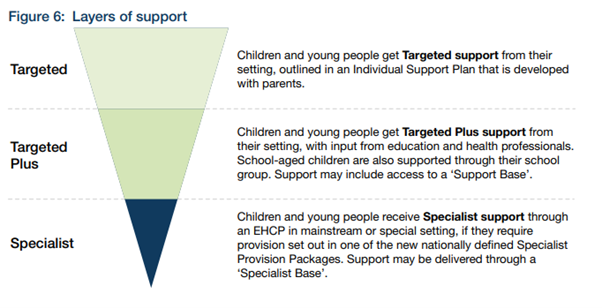
While it is not a guarantee that every child with a current EHCP will be able to keep it, it’s been reinforced by the Education Secretary Bridget Phillipson that the plan of the new system is to provide more support quicker for all pupils.
More specialist support in mainstream schools
To be able to provide specialist support early, the DfE is set to introduce the Experts at Hand programme. This service is set to increase the support available in mainstream schools, colleges and nurseries by offering access to specialist expertise. This includes occupational therapy, educational psychology, and speech and language therapy support.
The government pledged to give around £1.8 billion over the next three years for local areas to design and implement the new Experts at Hand offer develop this new service, which will be based on the needs of education settings, children and young people in their local area.
The aim of this programme is to provide better access to specialist support, which will reduce the number of children needing an EHCP in order to access the support they need because it will be readily available to them.
How schools can prepare for the SEND reform
The new SEND reform is layered and complex, but one thing is clear: the aim is to provide children and young people with accessible specialist support as early as possible. As more gets revealed and the plans are set in motion, schools should be prepared to enhance their current SEND provision, starting with training up their existing staff.
LMP Education has a range of SEND training programmes available for schools, from SEND Teaching Assistant pathways to Level 5 Specialist Teaching Assistant programmes. Learn more about our SEND training.
To discuss how LMP Education can support your school in developing your SEND provision, book a call with one of our SEND experts.
Book a call