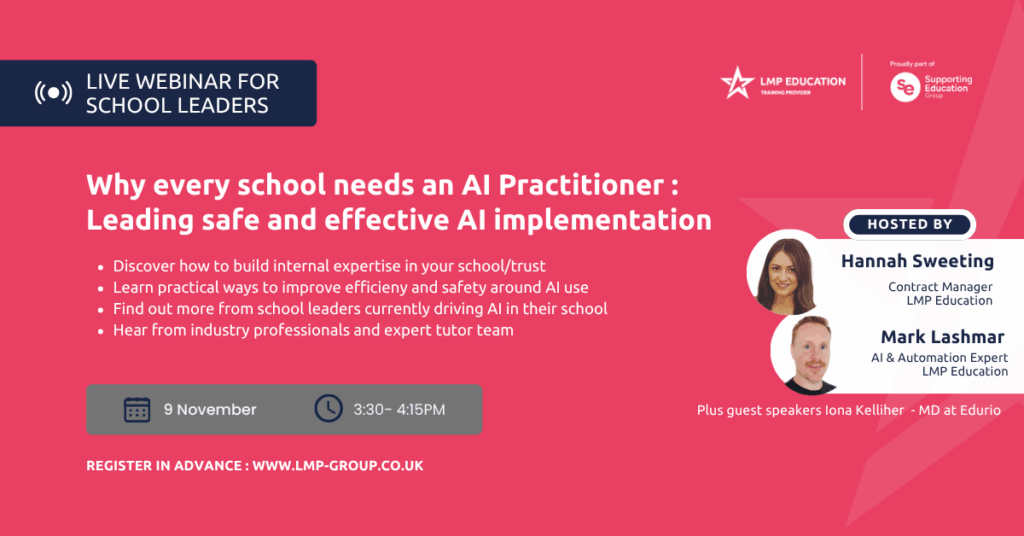

Join our live webinar for school leaders on Tuesday 9 November at 3:30pm
Why every school needs an AI Practitioner : Leading safe and effective AI implementation
Register in advance using this link https://us06web.zoom.us/webinar/register/9517929517923/WN_uXkM4Cc6ReGZrEUtK_TlCg
– Discover how to build internal expertise in your school/trust
– Learn practical ways to improve efficieny and safety around AI use
– Find out more from school leaders currently driving AI in their school
– Hear from industry professionals and expert tutor team
Join the LMP team as they are joined by school leaders and industry experts to discuss AI implementation in schools today.
As artificial intelligence continues to transform the way organisations work, school leaders are increasingly exploring how AI can be used to reduce workload, improve efficiency and prepare staff and learners for the future. However, alongside the opportunities come important considerations around governance, data protection, staff confidence and responsible implementation. The challenge for many schools is not whether to use AI, but how to introduce it safely, strategically and in a way that delivers genuine impact across the organisation.
Join LMP Education for this exclusive webinar on 9 November, where we will explore why every school should consider developing an AI Practitioner to lead and support the effective use of AI. Our expert panel will share practical examples of how schools are using AI to save time, improve processes and build internal capability, while maintaining high standards of safeguarding, GDPR compliance and educational quality. Whether you are just beginning your AI journey or looking to establish a more structured approach, this session will provide valuable insights, real-world experiences and actionable next steps to help your school embrace AI with confidence.
Register in advance using this link https://us06web.zoom.us/webinar/register/9517929517923/WN_uXkM4Cc6ReGZrEUtK_TlCg
Find out more about the Level 4 AI Practitioner for Schools training programme